
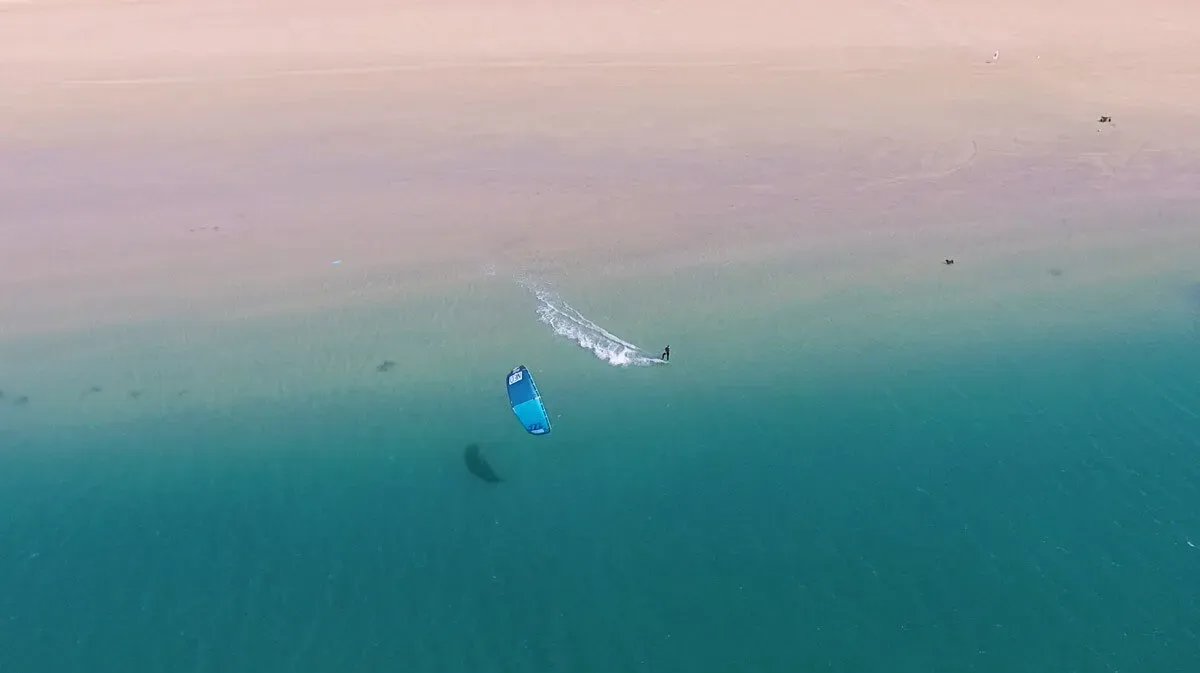
Dakhla is one of the best kitesurf destinations in the world: more than 330 windy days a year, a huge flat-water lagoon paired with ocean wave spots, mild weather all year, and eight spots within reach. It rides year-round, with the most consistent wind from April to September (often 25–35 knots in summer). Beginners and advanced riders alike thrive here. From our camp in the centre of the peninsula, most spots are minutes away — see our spots and our rooms.
Where Dakhla is, and why it’s a world-class kite destination
I’m Romano. I’ve been a kitesurf instructor since 2008, I’ve lived in Dakhla since 2017, and I’m writing this guide from the inside — from our camp, in the centre of the peninsula. If you only read one page about kitesurfing in Dakhla, make it this one: it’s everything I tell our guests over breakfast, spot by spot, season by season.
Dakhla is a long sand peninsula set on the Atlantic, in southern Morocco. On one side, a huge, shallow, sheltered lagoon; on the other, the ocean and its waves. That unique geography is the first reason for its reputation: you can go from a postcard-flat lagoon to ocean swell in the same day, simply by switching spots with the tide.
The second reason is the wind. We get more than 330 windy days a year — a huge figure that few destinations on earth can match. The wind is thermal, so it’s steady: it builds gently through the day and stays consistent instead of gusting. In summer it often blows between 25 and 35 knots. In other words, it’s rare to be stuck on land.
The third reason is the climate and the mood. It’s mild almost all year (around 20–25 °C in summer, 15–20 °C in winter), the sky is clear, and Dakhla remains an established, calm little kite town — nothing intimidating, even for a first trip to Morocco or a solo one.
And the fourth, more personal one: the location of our camp. We sit in the centre of the peninsula, a former farm turned green oasis, roughly halfway between the lagoon spots to the east and the wave spots on the ocean side. In practice we never cross the whole region: we read the morning’s wind and tide, pick the spot, and get there fast. Some are literally minutes from the door.
Dakhla’s 8 spots at a glance (closest first)
Here are our eight spots, ordered from closest to farthest from the camp, with the essentials for each. The full detail — exact distance, access, tides, disciplines — is on our spots; this is the overview to choose fast.
–West Point — 3–5 min · normal car · intermediate to advanced · waves. Our go-to on the doorstep, side-onshore. Perfect for an end-of-day session without driving anywhere.
–La Lagune — ~20 min · normal car · beginner & intermediate · flat water. THE spot to learn: flat water, steady wind, a big standing area and rescue boats on the water.
–Speed Spot — 15–20 min · 4x4 · all levels, tide-dependent. At high tide, a huge standing area ideal for beginners; at low tide, perfect flat water for speed and freestyle.
–La Sarga — ~30 min · 4x4 · all levels. The Swiss army knife: flat water and waves at once, offshore wind, with a rescue boat on site.
–Secret Spot — 25–30 min · 4x4 · all levels. Kite only, at mid-to-high tide; green seagrass carves out striking channels — the setting alone is worth the drive.
–Gold Point — 4x4 · intermediate to advanced · waves. On the ocean side, side-onshore and real waves: a spot for confident riders.
–Dune Blanche — ~45 min · 4x4 · all levels. The most spectacular: at big high tide, you surf around the dune and jump off it.
–Aarich — ~1 h · normal car · all levels · surf. The northernmost spot, sheltered by tall sand cliffs: you come here to surf, not kite, on a lovely light-wind day.
The right habit: the best spot of the day always depends on tide and wind, and that’s precisely what we fine-tune together every morning.
Best time: year-round, with a peak from April to September
The question I get most: when should you come? My answer fits in one line: Dakhla rides year-round. With more than 330 windy days a year, there isn’t really a “bad” season — just different moods.
–Spring (April–June): my favourite window. The wind builds in strength and regularity, the days grow longer, and there are fewer people than in high summer.
–Summer (July–September): the high season. The wind shows up almost every day, often 25 to 35 knots. Powerful, physical, ideal for fast progress and for advanced riders who want big wind. It’s also the busiest stretch.
–Autumn (October–November): a lovely transition. The wind is still very much there but eases off, crowds thin out, and things get calmer. A good middle ground.
–Winter (December–March): milder, a touch lighter, but often very steady. We still ride regularly. Ideal if strong wind intimidates you, or to pair kiting with relaxed desert exploration.
Temperatures are stable: around 20–25 °C in summer, 15–20 °C in winter. With the wind you always feel a bit cooler — bring something to cover up on the beach, even in summer. For more, we break it down month by month in our dedicated best-time guide.
Beginner or advanced: who Dakhla suits, and where to learn
Dakhla’s great strength is that it welcomes a first kite flight just as warmly as a rider charging into the wave. Here’s how I frame it.
If you’re a beginner: few places in the world are this forgiving. The lagoon gives you flat, shallow water where you can stand for hundreds of metres, a steady thermal wind that forgives mistakes, and rescue boats. You can stop, put your feet down, catch your breath, start again. I start almost all our beginners at La Lagune, and at Speed Spot at high tide when the tide suits. Partner schools collect you directly at the camp, and gear is provided. Plan on about a week to become independent.
A first lesson, by the way, never starts with jumps: we move step by step — wind theory and safety on land, piloting with a small trainer kite, then body drag in the water, and finally the water start with the board. Each stage is cleared without putting yourself at risk.
If you’re intermediate: you can taste it all. La Sarga and Speed Spot at low tide offer beautiful flat water to progress with confidence and get into freestyle, while La Lagune stays a comfortable playground for clocking up the miles.
If you’re advanced: head to West Point and Gold Point for waves and side-onshore, and Dune Blanche for a memorable session at big high tide. These spots reward those who can handle wave and wind — exactly what we love to commit to when conditions line up. The level-by-level detail is on our spots.
Beyond kiting: wingfoil, windsurf, surf and land sailing
Dakhla isn’t only a kite spot: it’s a playground for every wind and board sport. If the wind drops or you fancy a change, there’s always something to do.
Wingfoil and windsurf enjoy exactly the same steady wind and the same water: the lagoon and La Sarga are perfect for starting out or progressing on the foil, flat and safe.
Surf takes over when the wind eases. Aarich, sheltered by its tall sand cliffs, keeps clean, well-shaped waves — a lovely escape for a light-wind day. Dune Blanche also lets you surf around the dune at big tide.
And then there’s land sailing, my latest passion: I’ve run it in-house since 2025. It’s the easiest wind sport to start with — you learn in about twenty minutes, on the sand, with no water and no wetsuit. Ideal on big-wind days, or to give kids and non-kiters a first taste of gliding.
On top of that: e-bike, horse riding, quad and buggy, sailing and fishing, and desert excursions. You’ll find every camp activity, who runs it and how to book, on our activities.
How to get there: flights, airport, transfer and car
The easiest way to reach Dakhla is to fly. The town has its own airport (code VIL): from Europe or further afield, you usually connect through Casablanca or Agadir, then take a domestic hop down to Dakhla, generally with Royal Air Maroc. A few direct international charters top these up depending on the season — handy, but less regular, so check them when you book.
On the paperwork side, it’s usually straightforward: most nationalities enter Morocco visa-free for a tourist stay of up to 90 days. The rules do depend on your passport and can change, though — always check your own case against official sources before you travel.
The single most important thing to remember: no public transport reaches the camp, and city taxis can’t come out to us. Don’t count on grabbing a taxi off the plane to get here. Instead, we arrange a private transfer for you from the airport, at €20 per trip: you send us your flight number, and someone is waiting on arrival. The camp is only ~15 minutes away, roughly 5 km. The last ~250 metres run along an unpaved track, but it’s all signposted and the camp is lit at night.
Do you need a car? Not to reach the camp, and not for day-to-day riding — we take you out to the spots. A car becomes worthwhile if you want to explore the peninsula at your own pace or stack sessions independently; we can put you in touch with our local partner, Baie Car. For the closest spots (West Point, La Lagune) a normal car is plenty; but several of our best spots (Speed Spot, Secret Spot, Dune Blanche and more) can only be reached by 4x4, because of the track and the sand. All the arrival details are on getting here.
Budget and where to stay: the central-location advantage
Let’s talk practicalities. The real edge of staying here, beyond the wind, is our central location: you sleep minutes from most spots, which saves you precious time every day and turns “sessions” into full days on the water.
The camp has five rooms, all en-suite, from the most intimate to the most spacious: Art Room (15 m², 2 guests), Berber (23 m², up to 3), Desert (23 m², 2), Nature Bungalow (25 m², 2) and Fireplace Bungalow (30 m², 2). You can see them all, with photos and rates, on our rooms. We’re rated 9.7/10 on Booking.com, and breakfast is €6 per person.
On the food side, the cooking of Karima — born in Dakhla — is part of the experience: a three-course Moroccan dinner at €15/person (let us know before 11:00 the same day, it’s all cooked fresh) and a lunch tagine around €8. The full menu is on our dining.
For the rest of the budget, keep the main items in mind: the airport transfer (€20 per trip), an optional car rental via Baie Car, and your lessons or gear rental with the partner schools. The kiting itself is booked directly with them; we take care of the roof, the table and the daily logistics — and we point you to the right spot every morning.
Practical tips: wetsuit, what to pack, safety and how many days
The wetsuit, first. Dakhla’s water is cool because of the Atlantic current, but nothing icy. The right move is to match the suit to the season: in summer (roughly May to October), a shorty or a 3/2 mm is plenty; in winter (November to April), go for a 3/2 mm, or a 5/4 mm if you feel the cold. When in doubt, bring the slightly warmer option — with near-constant wind you cool down fast between runs.
What to pack: high-factor sunscreen and sunglasses (wind and sand), a windbreaker for the beach even in summer, and something to cover up in the evening. For gear, bring your own harness if you have one; kites and boards can be rented on site, but if you travel with a board bag, warn the airline — sports-baggage rules differ from flight to flight.
Safety: never head to a spot you don’t know without local advice, especially on wave spots and offshore spots. Always ask us for the day’s tide and wind before you choose — it’s free, and it’s exactly what we fine-tune together over breakfast. On isolated 4x4 spots, ride with company.
How many days? For a beginner who wants to become independent, aim for at least a week. For an advanced rider who wants the full variety — lagoon, waves, flat water, the dune — plan on 7 to 10 days to enjoy the different tides and wind windows without rushing. With more than 330 windy days a year, the chance of leaving without a single session is slim.
In short: ready to kite Dakhla?
Here’s the essence: Dakhla means more than 330 windy days a year, a flat-water lagoon paired with ocean waves, eight spots for every level, and mild weather all year. It rides in every season, with a peak from April to September. Beginner or advanced, there’s a window and a spot for you.
And from our camp, in the centre of the peninsula, you’re minutes from most spots, with a proper roof, Karima’s cooking, and someone reading the wind for you each morning. Pick your room on our rooms, explore each spot in detail on our spots, and plan your arrival on getting here.
A question about current conditions, your level or your gear? Message us via the contact page — it’s often me who answers, spot by spot. See you on the water. — Romano
Explore more
Want to experience Dakhla with us?
Check availability on Booking.com, or message us on WhatsApp — we’ll arrange your whole stay.