
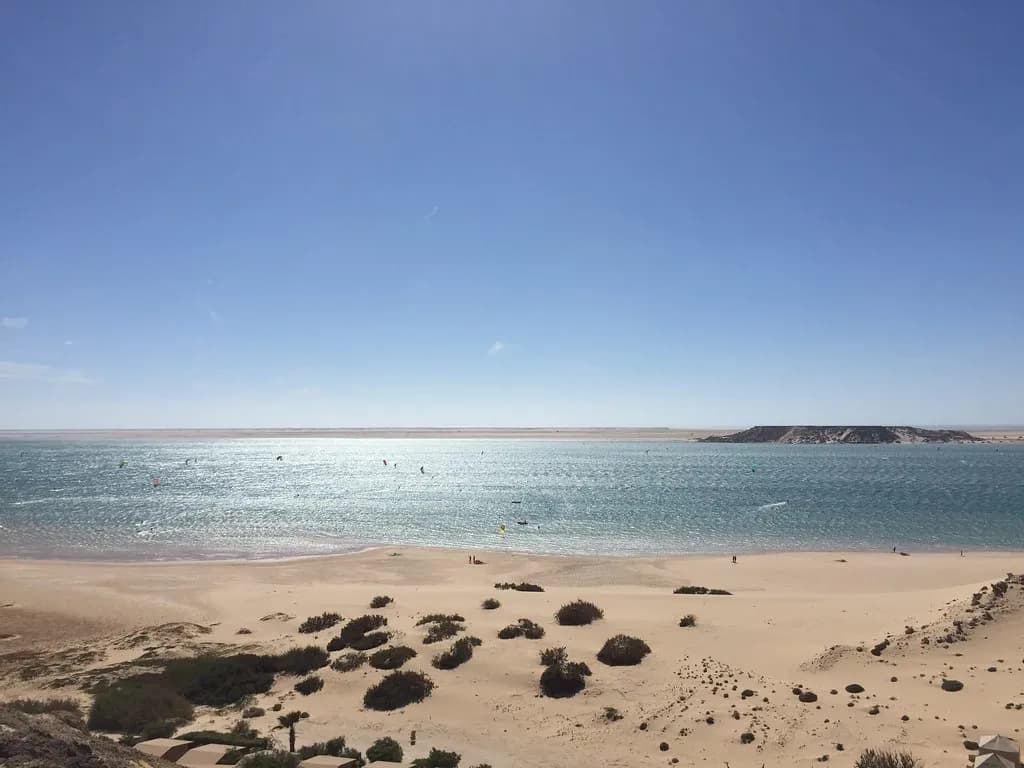
Dakhla lagoon is a huge, flat, shallow stretch of water about 20 minutes from the camp by normal car. It works at both high and low tide, with steady side-shore wind and rescue boats out on the water. The result: it’s the region’s best spot to learn kitesurf safely and, for advanced riders, an ideal freestyle playground. Beginner or expert, everyone finds their place here.
Part of our guide: Kitesurfing in Dakhla: The Complete Guide
The lagoon in one line: flat water, high tide or low
I’m Romano, a kitesurf instructor since 2008 and based in Dakhla since 2017. The question I get almost every morning over breakfast: “what exactly is the Dakhla lagoon?” Here’s my answer, first-hand.
The lagoon is a huge, flat, shallow body of water, sheltered from the ocean swell by a long spit of sand. About 20 minutes from the camp, you reach it in a normal car — no 4x4 needed. It’s the region’s learning spot par excellence, and at the same time one of the finest freestyle playgrounds I know.
Its great strength is that it works at high tide and at low tide. The spot changes face with the tide, but there’s almost always something to ride. Add a steady side-shore wind and rescue boats out on the water, and you can see why we bring nearly all of our beginners here. You’ll find the full listing, with photos, on our our spots page.
How the tide changes everything
In Dakhla the tide dictates almost everything, and on the lagoon it’s your best ally. That’s why I check the tide times before every outing — and why we often plan the day’s session together at the camp.
At low tide the water pulls back and uncovers big standing areas. That’s a gift for beginners: if you lose your kite or your board, you simply stand back up, calmly, no panic. The water is also flatter than ever — perfect for laying down your first runs or for freestyle on a mirror-smooth surface.
At high tide the water spreads out and deepens a little. You have your feet down less often, but you gain a vast, glassy playground for long runs, building speed and working on tricks. Depending on the tidal range and the time of day, the lagoon shifts from a reassuring learning pool to a wide speed plateau — sometimes within the same day. The right habit: ask us the day’s tide before you head out.
Side-shore wind: why it’s the right direction for learning
On the lagoon the prevailing wind is side-shore — it blows parallel to the shore. For learning, that’s the most comfortable and safest direction: it pushes you neither out to sea (offshore, best avoided when starting) nor hard onto the beach.
In practice, a side-shore wind lets you head out on the water and come back easily to the same place, without drifting far from where you started. That’s exactly what you want when you’re laying down your first rides: consistency and predictability.
And on consistency, Dakhla is hard to beat: more than 330 windy days a year, and in summer it generally blows between 25 and 35 knots. On the lagoon, that well-established thermal wind makes progress fast — you repeat the motions session after session without waiting days for the right window.
Why flat water matters this much
If the lagoon makes so many kiters dream, it’s above all for its flat water. And it isn’t just about looks: flat water genuinely changes how you learn and how you progress.
For a beginner, there’s no chop or waves to unbalance the water start or spook you. You focus purely on your kite and board, in a calm, readable environment. The learning curve gets noticeably shorter — I see it every day with our students.
For an advanced rider, flat water is the prime surface for freestyle. Landings are soft, you can load a clean pop, lock in your tricks and drill rotations without the sea getting in the way. That’s where the lagoon becomes a genuinely world-class technical arena: a beginner and a competitor can share the same water, each at their own pace.
Beginner or freestyle: each has their lagoon
The beauty of the lagoon is that it serves two very different crowds without ever pitting them against each other.
If you’re a beginner: this is where we start. You use the low tide and the big standing areas to learn to relaunch your kite, to try your first water starts and first runs, knowing you can stand back up at any moment. The rescue boats on the water add real peace of mind — for you, and for the family watching from the beach.
If you’re advanced and chasing freestyle: the lagoon is your ground. At high tide, the wide, glassy sheet lets you string together speed, jumps and tricks with nothing in the way. Many riders come to Dakhla precisely for these consistent flat conditions, rare elsewhere. And because the tide makes the spot breathe through the hours, you can alternate calm learning in the morning and big freestyle sessions in the afternoon.
How to get there from the camp
From the camp, the lagoon is about 20 minutes away, and it’s one of the region’s few big spots reachable in a normal car — no 4x4 needed. That’s another upside of being based in the centre of the peninsula: we’re roughly halfway between the lagoon spots to the east and the wave spots on the ocean side, and we pick the best one for the day’s wind and tide.
No car? Not a problem. If you take kitesurf, wingfoil or windsurf lessons, the school collects you directly at the camp and takes you out on the water. For getting around on your own, a car is handy, and we can help you rent one through our local partner. One thing to plan for: no public transport reaches the camp and city taxis can’t come out here — all the arrival and transfer details are on getting here.
To plan your stay: browse the lagoon and the other seven spots in detail on our spots, and pick your room among our five rooms on our rooms. In the morning we check the wind and tide together, and decide. If the lagoon is firing, believe me, we go. See you on the water. — Romano
Explore more
Want to experience Dakhla with us?
Check availability on Booking.com, or message us on WhatsApp — we’ll arrange your whole stay.