
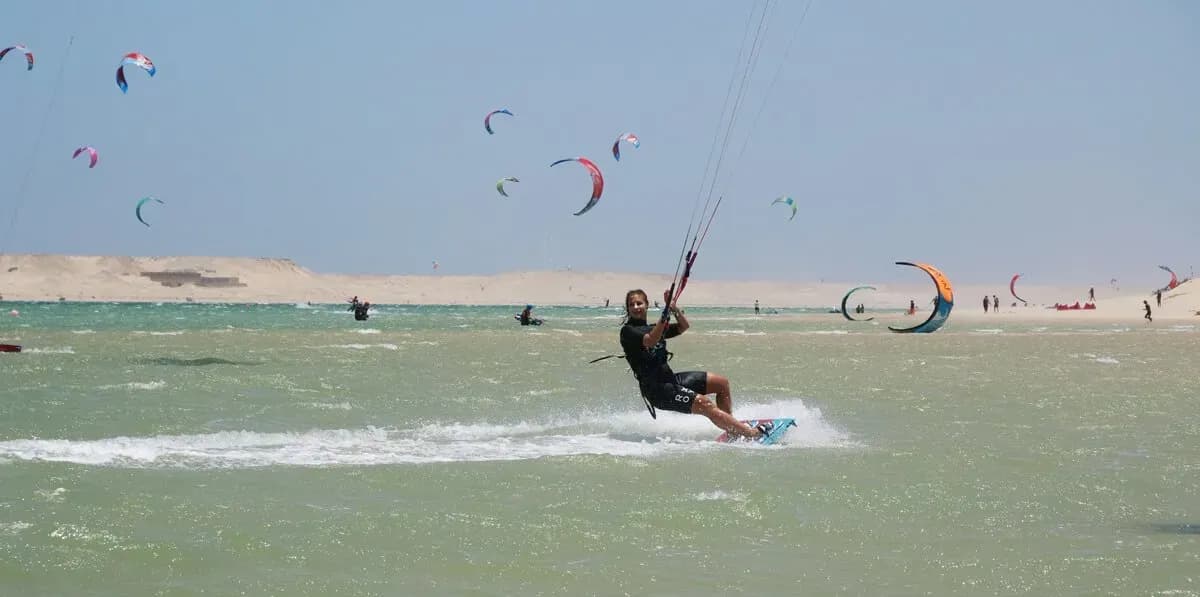
Dakhla is one of the best places in the world to learn to kitesurf: more than 330 windy days a year, steady wind and flat water. Two spots are ideal for beginners — La Lagune (~20 min, flat lagoon, rescue boats) and Speed Spot at high tide, with its big standing area. Partner schools collect you from the camp. Plan on a week to become independent; gear is provided.
Part of our guide: Kitesurfing in Dakhla: The Complete Guide
Why Dakhla is made for learning
I’m Romano. I’ve been a kitesurf instructor since 2008 and I’ve lived in Dakhla since 2017. I’ve put hundreds of beginners on the water — and I’ll tell you honestly: few places in the world are as forgiving for your very first kite flight.
The first reason is the wind. We get more than 330 windy days a year, and it’s thermal, so it’s steady. For learning, that’s everything: nothing is worse than gusty wind that lifts you then drops you. Here it builds gently through the day and stays consistent — the kind of wind that forgives beginner mistakes.
The second is the water. Dakhla’s big lagoon offers a huge, flat, shallow expanse where you can stand for hundreds of metres. No waves knocking you off balance, no unnerving depth: you can stop, put your feet down, catch your breath, and start again. That’s exactly what you want when you’re starting out.
And the third is the setting. It’s mild almost all year, the vibe is calm, and from the camp we plan each morning’s session around the wind and the tide. You’ve got nothing to organise: you come to learn, and we handle the rest.
The two best spots to start
There are eight spots around the camp, but for learning I only pick two, and I choose between them by the day’s tide. You’ll find them all in detail on our spots.
–La Lagune (~20 min, normal car). This is THE learning spot. Flat or near-flat water, steady side-shore wind, a big standing area, and rescue boats on the lagoon. That reassurance changes everything when you start: you dare a little more because you know you’re looked after. It’s where I start the vast majority of our beginners.
–Speed Spot at high tide (15–20 min, 4x4). At high tide this spot opens up a huge standing area — perfect for laying down your first runs with confidence, away from the crowd. At low tide it turns into a speed playground for advanced riders, but it’s the high-tide window that matters for learning.
The good news: between these two spots, we almost always find ideal learning conditions somewhere in the week. We check the tide, we choose, and off we go.
What a first lesson looks like
A first lesson doesn’t start with jumps, don’t worry. We move step by step, and each step is cleared without putting yourself at risk.
We begin on land: wind theory, the wind window, safety, and above all the release system — knowing how to disconnect from the kite in a single second. Then comes piloting with a small trainer kite, to feel the power without the risk.
Next we get into the water. You learn the ‘body drag’: sliding through the water pulled by the kite, without a board, to master the kite in its element and learn to recover your gear. It’s the most underrated stage, and yet the key to everything.
Finally, the board. We work on the famous ‘water start’: position the kite, tuck your legs, and let it pull you up. The first attempts are clumsy for everyone — that’s normal, and it’s exactly where having an instructor beside you makes all the difference. All the camp’s activities, including kitesurf, are on our activities.
How many days until you’re independent?
The question I get most. My honest answer: aim for a week.
In two or three days, most people manage their first runs and start to head slightly upwind — the moment it all clicks. But the gap between ‘I can get up on the board’ and ‘I’m independent, I come back to my start point on my own’ is exactly what takes the most time.
With a week here, we can string sessions together at the right point in the tide, let your body absorb things between days, and iron out the details calmly. That’s the ideal rhythm: neither rushed nor frustrating.
Everyone progresses at their own pace — age, fitness, and experience in other board sports all play a part. But with Dakhla’s steady wind and real days on the water, a week gives you every chance to leave as an independent rider. A long weekend is a lovely taster; a week is a skill for life.
Gear, safety and wetsuits
Good news: you don’t need to buy any gear. The partner schools provide everything — kite, board, harness, vest and helmet, sized to you and to the day’s conditions. You turn up empty-handed.
Safety is the heart of the job. An instructor stays close to you, often within earshot, and you learn the release from the very first hour. On the lagoon, the rescue boats add a real safety net — that’s another reason I prefer it for beginners.
For the wetsuit, match it to the season rather than guessing an exact water temperature: in summer (roughly May to October), a shorty or a 3/2 mm is plenty; in winter (roughly November to April), go for a 3/2 mm, or a 5/4 mm if you feel the cold. When in doubt, bring the warmer option — with near-constant wind you cool down fast between runs.
No car? Not a problem: if you take lessons, the school collects you directly from the camp and drops you back. All you have to do is pull on your wetsuit.
The best season to start, and where to stay
Dakhla is a year-round kite destination, but for learning I often suggest spring, autumn or winter. The wind is very much there but less muscular than in high summer, when it often blows 25 to 35 knots. Learning in a steady 20 knots is more pleasant — and safer — than in big wind.
That said, summer works very well for beginners too: there are simply more people on the water and stronger wind. If you’re torn over the ideal window, message me before you come via the contact page and I’ll tell you honestly what the current conditions are doing.
For accommodation, you sleep at the camp, in the centre of the peninsula, in one of our five en-suite rooms — from the cosy Art Room to the roomy Fireplace Bungalow. It’s ideally placed to reach both the lagoon and Speed Spot quickly. You can see them all on our rooms.
So, ready for your first kite flight? Book your room, tell us your dates and your level, and we’ll set up the lessons together. A question about conditions, gear, or the best time to come? Write to us via the contact page — it’s often me who answers. See you on the water. — Romano
Explore more
Want to experience Dakhla with us?
Check availability on Booking.com, or message us on WhatsApp — we’ll arrange your whole stay.