
To stay well in Dakhla as a kiter, pick a central base that’s close to as many spots as possible, arranges your transfers, feeds you properly and lets your gear dry. Town is convenient but far from the water; the lagoon-front is beautiful but ties you to a single stretch of water. The centre of the peninsula keeps every spot 3–60 min away, so you can follow the day’s wind and tide instead of your address.
Part of our guide: Kitesurfing in Dakhla: The Complete Guide
What to actually look for before you book
I’m Romano, a kitesurf instructor since 2008 and based in Dakhla since 2017. I’ve seen plenty of riders book a gorgeous place… then lose an hour on the road to every session. So before we talk neighbourhoods, here’s what I’d check if I were booking a kite trip to Dakhla today.
–Position relative to the spots. This is criterion number one. Dakhla isn’t a single stretch of water: there’s the lagoon to the east, wave spots on the ocean side, and a handful of 4x4-only spots in between. Wind and tide change daily, so the ideal is to be close to as many spots as possible, not glued to just one.
–Transfer and logistics. No public transport reaches the camp, and city taxis can’t drive out onto the track. A good base arranges your airport transfer (with us, €20 per trip, ~15 min) and gets you to the water. Without that, you’ll rent a car just to function.
–The food. After five hours in the wind, you won’t want to hunt for a restaurant. A generous breakfast in the morning and a real dinner at night change a whole trip.
–Gear-friendly and calm. Room to pump and dry your kites, a quiet place to sleep, and hosts who speak kite. It sounds obvious, but not everything is built for riders.
In town: convenient, but far from the water
Staying in the town of Dakhla has its upsides: restaurants, shops, cash machines, a quiet nightlife and easy taxis. If you’re here to sightsee as much as to kite, or you’re travelling with non-riders, it’s a sensible pick.
But for a kite-focused trip, town has one real flaw: it’s far from the spots. The Dakhla peninsula is long and narrow, and most of the good water sits outside the city. You end up driving morning and evening, often against the light and the wind, when the ideal session shifts with the tide.
Put simply: town is comfortable to sleep in, less so to ride from efficiently. Unless kiting is only part of your trip, I’d keep it for an evening or two, not as your base camp.
Lagoon-front: beautiful, but a single body of water
The other big option is to sleep right on the Dakhla lagoon. And honestly, it’s stunning: you rig your kite, walk to the water, and ride. For a beginner or intermediate who wants to clock up runs on flat water, it’s hard to beat.
The trade-off is that you’re married to a single spot. The lagoon is perfect for learning and for flat-water freestyle, but it doesn’t do everything. On wave days, ocean spots like West Point or Gold Point are far away; and when the tide doesn’t play nicely on the lagoon, you have no plan B next door.
So the lagoon-front is ideal if you’re coming specifically for that water, and a little less so if you want to taste all of Dakhla’s variety — waves included. You’ll find the detail of each of our eight spots, distance and level, on our our spots page.
The centre of the peninsula: every spot 3–60 min away
There’s a third option, and it’s the one I make the case for — because it’s where we’re based. The camp sits in the centre of the peninsula, roughly halfway between the lagoon spots to the east and the wave spots on the ocean side. The result: you never cross the whole region.
In practice, from our door West Point is 3–5 minutes away, the lagoon about twenty, and even our best 4x4 spots (Speed Spot, Secret Spot, White Dune…) stay short outings. The farthest, Aarich to the north, is about an hour. Everything fits inside a 3-to-60-minute range.
It changes how you ride. You wake up, check the wind and tide, and pick the day’s spot — flat in the morning, waves in the afternoon if the mood and conditions line up. You follow the forecast, not your address. That’s exactly why a central base feels like the best compromise for a genuine kite trip.
Eating, sleeping and drying well: life at the camp
A good kite base isn’t only about distance to the spots. It’s also what waits for you when you get back. Here, Karima cooks every day: breakfast is €6 — fresh bread, eggs, yoghurt, fruit, mint tea — and in the evening, a three-course Moroccan dinner (€15/person) that our guests love. Just let us know before 11 a.m. if you’d like to eat with us. Full details are on our dining.
On the sleep side, we have five rooms, all en-suite, from the cosy Art Room (15 m²) to the Fireplace Bungalow (30 m², with a stone fireplace and a terrace). Each has its own mood, between tadelakt, carved wood and garden. You can see them all, with sizes and capacities, on our rooms.
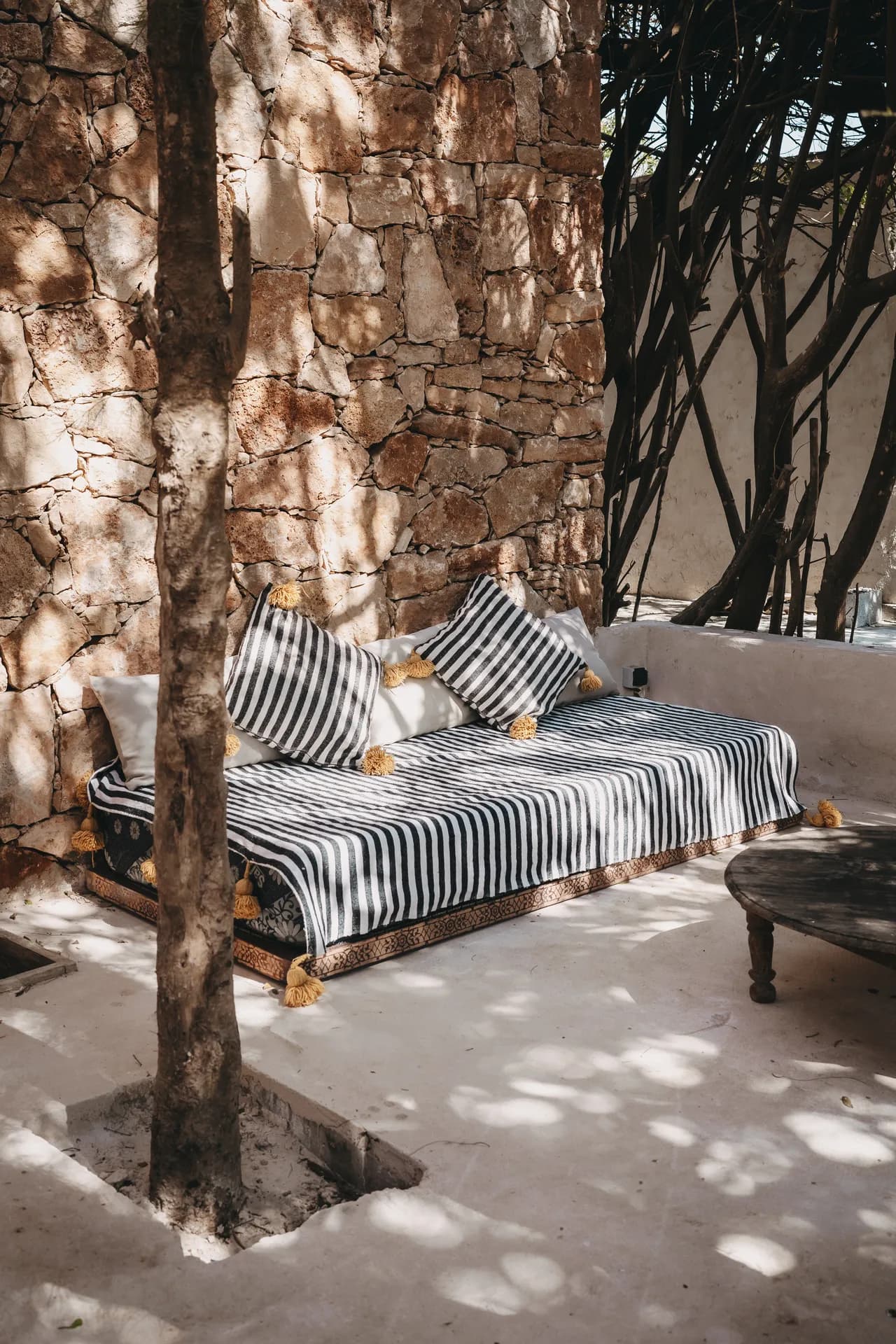
And because this is a former farm turned green oasis, there’s space and quiet: room to pump and dry your kites in peace, shade to sit in between sessions, and real recovery. The unpaved track for the last 250 metres is lit at night, so even a late arrival is stress-free.
In short: which choice for which trip
There’s no wrong answer, just the one that fits your trip. Town if you’re mixing sightseeing with kiting or travelling with non-riders. The lagoon-front if you’re coming for that exact water and nothing else. And the centre of the peninsula if you want to follow the wind everywhere, alternate flat and waves, and keep every spot within reach.
For a full-on kite trip, with the most sessions and the least logistics, it’s that central base I’d recommend — transfers arranged, home cooking, five rooms, and the water never far.
A question about current conditions, your level or the best room for you? Write to us via the contact page — it’s often me who answers, spot by spot. See you on the water. — Romano
Want to experience Dakhla with us?
Check availability on Booking.com, or message us on WhatsApp — we’ll arrange your whole stay.